
Sarajevo Pride organisers still pay for their own protection, Bosnian rights group finds
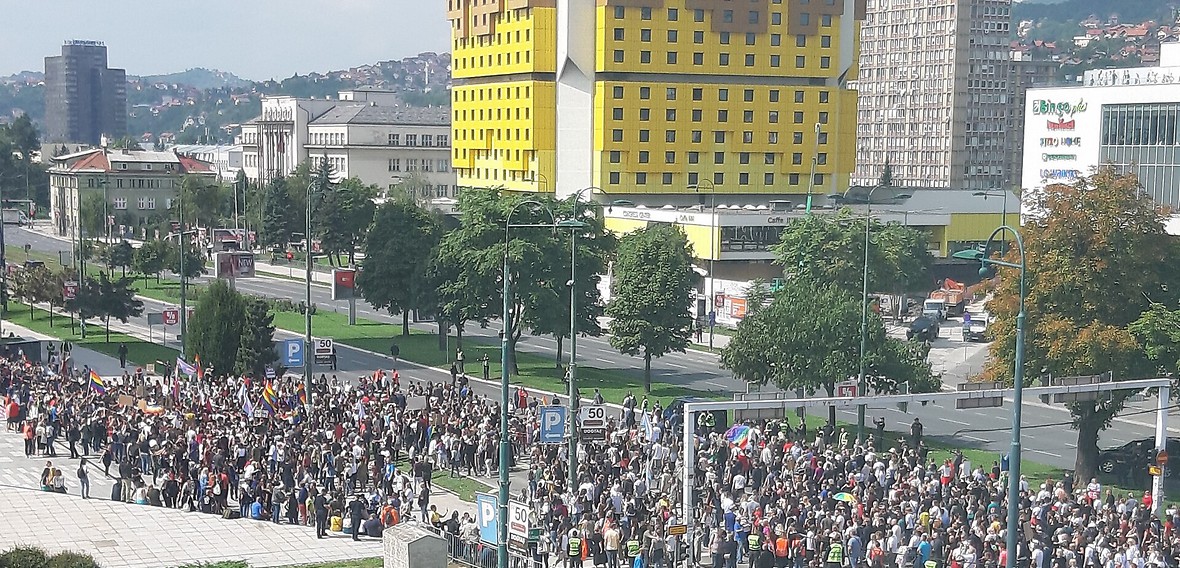
Sarajevo Open Centre (SOC), Bosnia and Herzegovina’s leading LGBTI and women’s rights organisation, has published a report on freedom of assembly in the country, covering 1 January 2025 to 1 July 2026. It looks at how institutions treat people who take to the streets, from students and workers to environmental campaigners and the LGBT+ community. The report, written by Dejan Lučka, was supported by ILGA-Europe.
Its overall finding is that freedom of peaceful assembly was attainable, but not equally for everyone. In practice it depended on which law applies where (Bosnia is split into two entities, ten cantons in the Federation and the Brčko District, each with its own rules), on the location and topic of a gathering, on how the authorities responded, and on the organisers’ resources. Newer laws in Brčko and several Federation cantons offer better protection, while significant gaps remain in Republika Srpska and some cantons, and even better laws have not always changed old habits.
Pride goes ahead, at a cost
The sixth and seventh Bosnian-Herzegovinian Pride Marches took place in Sarajevo in 2025 and 2026 under the slogans “Love is law” and “All colours suit us well”, both without major incidents. But the report warns that the march happening does not mean LGBT+ people can freely exercise the right to assemble. Talks with institutions have to start six months in advance, and organisers must themselves coordinate the application, route, traffic arrangements and security measures.
The biggest unresolved problem, it says, is that the burden of security is shifted onto the organisers: fencing, private security, stewards and extra paperwork. The OSCE Mission to Bosnia and Herzegovina previously observed that concrete barriers, metal fences and private guards had cost almost BAM 100,000 (about €51,000) in earlier years. SOC calls this a logical paradox: tighter security is needed because of threats from the march’s opponents, creating “an absurd situation in which victims finance their own protection from violence”, while those who pose the danger face no consequences.
There has been progress. Cooperation with individual police officers has become better and more predictable, there are fewer physical barriers, and ahead of the 2026 march Sarajevo Canton police announced a phased, temporary suspension of traffic along the route. Police responded swiftly to a verbal attack at the latest march; in 2025, two queer visitors from Istanbul were attacked on the eve of Pride, and a member of the community was slapped in the face just after it ended.
Nothing outside Sarajevo
No city other than Sarajevo has seen a comparable public gathering of the LGBT+ community. The report points to organisational and security hurdles, but also to a conservative society marked by deep homophobia and traditional gender roles. The key example remains the March 2023 attack in Banja Luka on members of the Pride organising committee, preceded by hate speech, threats and statements by the then president of Republika Srpska and the Banja Luka mayor disputing LGBT+ rights. No one has been prosecuted for the physical attack, although the Basic Court in Banja Luka found in a first-instance civil judgment that the then president’s statements discriminated against LGBT+ people.
Testimonies from Banja Luka activists show those events still shape their sense of safety and willingness to speak out. “The absence of new clashes does not necessarily mean that the protection has improved,” the report says: vulnerable people may simply have stopped organising protests or moved their activities indoors.
Among its recommendations, SOC calls on the authorities to stop shifting disproportionate costs onto organisers of peaceful gatherings and to cover them as part of their duty to facilitate assemblies, to amend rules that restrict gatherings by default to a few designated locations, and to give organisers a named police contact.
Source: soc.ba. English adaptation: gay-serbia.com.