
Bosnia and LGBT: “I was born in Banja Luka and I live here — where do I go now?”
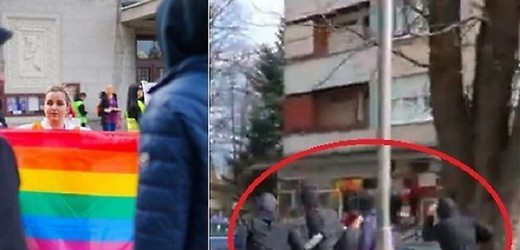
Bosnia and Herzegovina and LGBT: “I was born in Banja Luka and I live here — where am I supposed to go now?”, activists ask after the attack on the organisers of the BiH Pride March.
Several dozen men in black, with hoods pulled over their heads, attacked activists, journalists and the organisers of the BiH Pride March on Saturday evening in Banja Luka.
Two minutes like an eternity.
That is how it felt to Melani Isović on Saturday evening, 18 March, when dozens of hooded men in black attacked her and the other organisers of the BiH Pride March in Banja Luka, in Republika Srpska, one of the two entities of Bosnia and Herzegovina.
The activists had gathered in the offices of Transparency International when police officers told them they had to leave.
“It all happened so fast that I wasn't even aware of it — I'm still not, because I had to leave my own city over threats to my safety,” Isović tells BBC News in Serbian, from a place she describes as safe.
The activists had planned several indoor events; there was no intention of going out onto the streets.
Earlier that day, the Banja Luka police directorate had banned all the events the march organisers had planned, with the explanation that “after a series of threats, the activists are endangered and their safety cannot be guaranteed”.
“According to our preliminary legal analysis, the manner and content of the ban violate the principle of freedom of assembly.
“The message this sends is that the question of potential violence was solved by banning the BiH Pride March events — by banning the assembly, not the violence,” the activists responded.
After Saturday's attacks, the activists and members of the organisation left Banja Luka.
The duty prosecutor of the Banja Luka District Public Prosecutor's Office told BBC News in Serbian he had been informed that on Saturday “several unidentified persons masked with balaclavas physically assaulted a group of citizens in a public area, in which attack two persons sustained bodily injuries”.
“The prosecutor instructed the officers of the Banja Luka police directorate to undertake all necessary investigative actions and measures to identify the perpetrators of the criminal offence of violent behaviour under Article 362 of the Criminal Code of Republika Srpska, and to establish all the circumstances of the event,” the institution said in a written reply.
The attacks were condemned by Draško Stanivuković, the mayor of Banja Luka.
“I condemn every kind of violence, but our position in no way contributed to this. Those are malicious claims,” he wrote on Twitter.
He added that “Banja Luka will remain a bastion of traditional patriarchal family values”, of which he is proud, “without touching anyone's right to love whom they want — but not to parade about it”.
“I call on the police to do their part of the job responsibly and to resolutely suppress every kind of violence,” the mayor said.
Two days earlier, Milorad Dodik, the president of Republika Srpska, had announced that the entity's authorities would prevent any event dedicated to LGBT rights, whether indoors or out, because “they disturb others”.
What happened?
“We wanted to screen the film Pride, hold a panel discussion, and then socialise — all indoors,” says Melani Isović.
The activists' conversation that Saturday evening was interrupted by the doorbell.
“A colleague went to answer it, and after a minute or two she came back visibly frightened and shaken.
“A police officer had told her we had to leave the premises because we were going to be attacked,” says the 30-year-old.
At that moment there were nine of them in the offices.
“We leave the premises, others join us, and then the police officer tells us he cannot guarantee our safety and that we should go back where we came from.
“‘I'm from Banja Luka, I was born here, I live here — where am I supposed to go?', I asked him. He looks at me and just says: ‘I don't know either',” Isović recounts.
They were trying to work out where to go, whether they had enough cars, she says, when a shout interrupted them: “There they are.”
“We scattered. I was in a group that was mostly women and two men, whom the attackers didn't see.
“They didn't physically assault us, but they hurled insults and shouted ‘Kill the faggot', ‘Banja Luka is clean', ‘We'll kill you, get out of here'.”
As she speaks, her voice trembles.
“I can't give an exact number, but I think there were several dozen of them. I saw they were in black, with hoods, and that two police vehicles were nearby — but they didn't approach us.
“After five minutes a large number of police officers appeared and told us we were safe, and they wanted to take us to the police station — but I didn't feel safe. I didn't trust them then, and I don't now.”
The activists filed criminal complaints, then left Banja Luka.
What do the laws say?
The prohibition of discrimination against LGBT people in Bosnia is regulated by the 2003 Law on Gender Equality and the 2009 Law on the Prohibition of Discrimination, which stipulates that people must not be discriminated against on the grounds of sexual orientation or gender identity.
Under the Criminal Code of Republika Srpska, a hate crime includes, among other things, an offence committed because of sexual orientation or gender identity.
“Whoever, on the basis of a difference in sexual orientation or gender identity, denies or restricts a freedom or right established by the Constitution, law or international treaty — shall be punished by a fine or imprisonment of up to three years,” the law says.
If this kind of discrimination is committed by an official abusing their position or authority, harsher penalties apply — between six months and five years in prison.
In 2018, the government of the Federation of BiH accepted an initiative to create a legal framework for recognising same-sex unions, along the lines of laws that already exist in Croatia, Slovenia and Montenegro.
The other entity, Republika Srpska, never even considered the initiative.
On 4 April 2022, the Municipal Court in Sarajevo handed down a first-instance ruling that, for the first time in BiH, judicially confirmed discrimination against LGBT people — a ruling many activists welcomed as “historic”.
For the British ambassador Julian Reilly, Saturday's violence was unacceptable, while the US embassy in BiH called it a vile act.
“We condemn the violence in Banja Luka in the strongest terms. Words have consequences.
“When civil society activists and journalists are regularly the target of verbal attacks by politicians from Republika Srpska, it creates a climate in which physical attacks can follow,” the EU Delegation in BiH posted on its official Twitter account.
Small steps, but not enough
The first Pride March in BiH, under the slogan Ima izać' (Time to Come Out), was held in Sarajevo in 2019.
“It passed without a single incident and it is a bright example — progress is visible — but none of it is carved in stone, and events like this one in Banja Luka tell us things can easily head in the wrong direction.
“The biggest problem is that the position of the LGBT community is not the same everywhere — some parts of the country show improvement, while some regions are going backwards,” Darko Pandurević of the Sarajevo Open Centre tells BBC News in Serbian.
The events on the streets of Banja Luka remind him of the 2014 attack on the Merlinka film festival in Sarajevo.
“Then too there was a build-up of tension, politicians got involved, a charged atmosphere — and certain groups of fans hungry for violence took the bait,” he adds.
So far the Pride March has been held only in Sarajevo, and Pandurević doubts it will be possible in other cities any time soon, although that is the activists' goal.
Isović says the tense atmosphere in Banja Luka had been felt since the 8 March Women's Day march, when, as she says, one activist had a rainbow flag snatched away and another was shoved.
“That was when the campaign against the Pride March began — and I also blame the politicians who put wind in its sails.”
Twelve days later, the police identified four minors who took part in that attack.
Since Saturday, Isović has been in a safe place, like the other members of the organisation, but she still feels unsafe.
“It is very hard for me not to be with my friends and family, to have their support.
“When you have a problem and feel threatened, you call the police — and I don't trust them. I don't feel safe,” the activist adds over the phone.
When she will return to her home town, she does not know.
“We were supposed to get out of the way for just a day or two, but now they're advising us to stay a few days longer — how many, I don't know,” she adds after a short pause.
Source: BBC News na srpskom. English adaptation: gay-serbia.com.