
www.gay-serbia.com
|
www.gay-serbia.com |
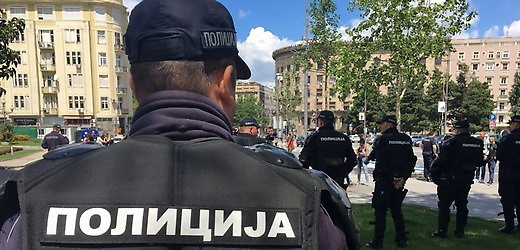
To make their voices heard, members of the LGBT community in the Balkans had to wait for the new millennium.
After the wars, inflation, sanctions and the other hardships that engulfed the region in the 1990s, it was only the 21st century that opened the way for the struggle for LGBT rights.
From conference halls, activism slowly moved onto the streets.
Today every capital in the region has a Pride, festivals and workshops are organised. But it was not always so — and the road to the full rights and freedoms of the LGBT community is still a long one.
Although same-sex relations have not been a criminal offence in most of these countries since the mid-1990s, the Western Balkans is still far from same-sex marriage.
Until 31 January 2023, when a law allowing same-sex marriage — and adoption within it — came into force in Slovenia, this form of union was not permitted in a single country of the region.
Meanwhile, the LGBT community in Serbia has been waiting more than 12 years for its rights to take legal form.
That is how long it has been since the first draft of a law on registered same-sex unions was written in 2010.
Serbia came closest to passing the law in 2021, when the Ministry for Human and Minority Rights launched the adoption procedure.
That procedure has now been sent back to square one, even though the document has long been at the draft-law stage and was submitted to the Serbian government, the daily Danas reported in June 2022.
Croatia moved earlier: in 2014 it passed the Law on Life Partnership for same-sex couples, giving them the same legal rights as married heterosexual couples.
The position of LGBT people in the Balkans improved somewhat in July 2020, when Montenegro voted through its Law on Life Partnership of Same-Sex Couples, giving the community the same rights as heterosexual couples, including health and social protection.
The first same-sex partnership in Montenegro was concluded on 25 July 2021.
Adoption remains off-limits to same-sex couples in Croatia, as in Montenegro.
Still, a 2022 ruling of Croatia's High Administrative Court allowed one gay couple to apply to adopt — described by many as a “historic ruling” that opened the door for other same-sex couples to begin the same process.
A same-sex marriage law is not just about the wedding itself — it carries a series of rights that gay couples are denied while it remains unpassed.
If such a law were adopted, gay couples would have the same rights as heterosexual ones: they could marry, hold joint property, inherit from each other.
They would also have the right to social insurance, hospital visits, joint care of children — and the obligation to care for a partner's child if there is no closer relative.
None of these rights exist for gay couples in Serbia, Bosnia and Herzegovina, North Macedonia, Albania or Kosovo.
For most gay people in Serbia, parenthood is out of reach — unmarried women cannot access IVF, surrogacy is banned, and adoption is nearly impossible for those who are not married.
The news that Serbia's prime minister Ana Brnabić had a child with her partner Milica Đurđić drew reactions from the LGBT community in Serbia.
“It is important to congratulate the prime minister on the birth of her child. But this is, unfortunately, just one more example showing that parenthood is a right not everyone has,” Jovanka Todorović of the Geten Centre for LGBT rights told the BBC earlier that year.
Although each of these countries has over the years adopted an anti-discrimination law which, among other things, prohibits discrimination on the grounds of sexual orientation, the LGBT community remains among the most exposed to it.
According to the 2017 report of the United Nations Development Programme (UNDP), the LGBT population is one of the most discriminated-against groups in Serbia.
“Citizens of Serbia keep the greatest social distance towards LGBT people, and an equal distance exists towards LGBT people within the family,” the report says.
The 2009 law prohibits discrimination on the grounds of sexual orientation and gender identity. The state is also bound by nearly all UN human rights treaties, the European Convention on Human Rights and numerous Council of Europe conventions.
Yet, as the report notes, “international organisations, state human rights institutions and NGOs point to problems of weak and inconsistent protection of LGBT people's rights in practice”.
Croatia has likewise recorded “a further rise in discriminatory speech and practice by right-wing radical MPs and representatives of clero-fascist organisations and initiatives”, Zagreb Pride's 2018 report says.
In their public appearances that year they “spread the hysteria of ‘gender ideology', pathologising trans people, and through inconsistent legislation excluded life partners”, the report says.
In Bosnia, the prohibition of discrimination against LGBT people is regulated by the 2003 Law on Gender Equality and the 2009 Law on the Prohibition of Discrimination.
Laws notwithstanding, the Sarajevo Open Centre's Pink Report for 2019 assessed that “the institutional framework for protection against discrimination remains markedly weak”.
In 2017 the Ministry for Human Rights and Refugees drew up a draft action plan for the equality of LGBT people in Bosnia and Herzegovina 2018–2020 and sent it to the entity governments.
The report concludes that mild progress has been made, but that it is uncertain when adoption will follow.
Montenegro's parliament passed its anti-discrimination law in 2010, the same year as Albania, while Kosovo adopted one in 2004.
North Macedonia has had an anti-discrimination law only since 2019.
According to the report of the Skopje LGBTI Support Centre, progress is visible in this field.
“Still, an increased number of hate speech cases has been recorded, in parallel with the increased visibility of members of the LGBTI community,” the report notes.
Regardless of legislative progress and successfully organised Pride walks in cities across the region, violence is one of the main problems LGBT people face.
Sexual orientation and gender identity were the motive in 42 cases of violence and discrimination recorded in Serbia by the organisation Da se zna in 2018. The number of attacks reported to the organisation was thirty percent higher than a year earlier.
“Perhaps we have encouraged more people to report violence, but I am sure the number of unreported cases remains high and dark,” Miloš Kovačević, author of the research documenting unlawful acts against LGBT people, told BBC News in Serbian that June.
Serbia's first criminal verdict in which a hate motive was taken into account in sentencing was handed down on 2 November 2018.
According to Human Rights Watch data from 2017, the Sarajevo Open Centre recorded 39 cases of hate speech that year, mostly on social media and online portals, seven cases of discrimination and 23 hate crimes against LGBT people.
The following year it documented 39 cases of hate speech and incitement to violence and hatred, and 33 criminal offences and incidents motivated by prejudice.
LGBT Forum Progres, an organisation promoting and protecting human rights and improving the quality of life of LGBT people in Montenegro, has since 2011 run systematic monitoring of social acceptance — of cases of violence, discrimination, hate speech and hate crimes against the LGBT community.
According to its 2018 report, a total of 239 cases were submitted to the police directorate and state prosecutors between 1 October 2016 and 1 October 2017. Misdemeanour proceedings were requested in just 18 cases, of which seven were concluded.
The situation in Croatia is improving: according to Zagreb Pride's report, no hate crimes against LGBT people were reported during 2018.
“But we monitor and support people whose cases still have no judicial resolution after several years, because of ineffective and slow court proceedings,” the report says.
In North Macedonia, 43 cases of hate speech were recorded during 2018, according to the annual LGBT human rights report by ILGA-Europe.
The same organisation tracked the situation in Kosovo and Albania.
“Human rights defenders, especially LGBT activists, were targets of threats and online hate speech. Still, during 2018 not a single physical attack on activists was recorded in Kosovo,” the report says.
In Albania, 45 hate crimes against LGBT people were recorded during 2018. The police investigated none of them. In one case, a police officer asked the victim, a trans woman, to withdraw her complaint, guaranteeing her safety. The same person was attacked two weeks later — by the same attacker.
Some of the first attempts at Pride in the Balkans in the early 2000s ended in violence, followed by years of bans on security grounds.
Belgrade's 2001 Pride parade ended in bloodshed when participants were attacked by members of right-wing groups.
Until 2010, Pride was not held, for security reasons. That year LGBT activists walked through Belgrade surrounded by a police cordon, while outside the protected circle hooligans demolished the city centre.
Dozens of citizens and police officers were injured.
LGBT people and activists again did not march “for security reasons” until 2014 — with the exception of a midnight protest walk in 2013 — after which Pride began to be held regularly in Belgrade, without incident.
Belgrade now has two Prides: alongside the June event, the Pride Parade proper is held in September.
In May of that year, Novi Sad held its first Pride Week.
Croatia has the longest history of Pride walks — the first Pride March was held in Zagreb in 2002.
Eighteen Pride Marches have been held in the Croatian capital so far, and since 2011 Split has marched as well.
In Montenegro, the Pride Parade was first held in July 2013 in Budva, followed by a gathering in Podgorica that same October. It has been held regularly since, with the exception of the Nikšić Pride banned in 2015.
Tirana got its first Pride the same year as Budva.
Kosovo, too, has a Pride Parade, held without incident in Pristina since 2017.
On 29 June of that year, Skopje was painted in rainbow colours for the first time. More than a thousand people took part in Skopje Pride — the first Pride Parade in North Macedonia.
North Macedonia's prime minister offered support on social media, and the singer Tamara Todevska dedicated her song Proud to the participants of the first Pride.
Nor was North Macedonia the only country in the region to get a Pride that year — the first Pride March in Sarajevo was announced for 8 September.
Source: BBC News na srpskom. English adaptation: gay-serbia.com.