
www.gay-serbia.com
|
www.gay-serbia.com |
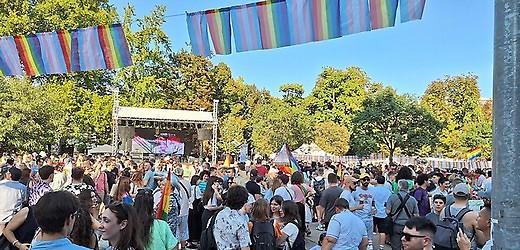
Fear, shame, unease. That is how Petar* from Vrnjačka Banja describes growing up.
“When you're gay in a small town, it's like wearing a label on your forehead,” he tells BBC News in Serbian. Petar is 24 now, and he still remembers what it felt like to live “under a magnifying glass”. “In a place where everyone knows everyone, rumours spread fast and privacy doesn't exist. I never felt I could freely be who I am,” he says — an experience far from rare.
“In small communities the places to work, go out and meet people are few, and LGBT+ people don't have much choice. In that atmosphere, most choose to hide their sexual orientation or gender identity so they don't become targets of homophobic violence,” Bojan Lazić of the organisation Da se zna (Let It Be Known) explains for the BBC.
Recent events in Pirot show that tensions around the LGBT+ community can still be felt in smaller towns. The city was meant to be one of the first stops of the Pride Caravan on 18 July, a tour planned to continue through five more towns: Vranje, Zaječar, Kraljevo, Šabac and Loznica. The caravan's goal is for Pride activists and organisers to promote LGBT+ rights across the country and announce the Belgrade Pride march.
Before the caravan reached Pirot, protests were held against the announced event, and organisers reported threats sent to activists on social media.
“Although we registered the Pirot gathering in line with the law, our public assembly was banned, while an unregistered, unlawful gathering of hooligans and football ultras — who shouted homophobic slogans and attacked and injured journalists — was protected by a police force that watched it all in silence,” Lazić says. The Interior Ministry did not answer the BBC's questions about the incidents in Pirot before publication, but stated that two suspects had been arrested for hitting an N1 television journalist and cameraman with a tomato.
Although Serbia is an official candidate for European Union membership, LGBT+ people there remain exposed to high levels of discrimination, hate speech and violence, with trans people most at risk, the European Commission's 2025 report on Serbia notes. There has been no progress on a same-sex partnership law or on the legal recognition of gender identity, adds the annual report of the Commissioner for the Protection of Equality.
In 2019, Filip Vulović told the BBC what it was like to grow up LGBT in Kragujevac — another year in which caravan events in several Serbian towns were cancelled. “At that point I still hadn't come out to my family. I remember saying I wanted to do it gradually, by first bringing the subject of the LGBT community closer to the people I love,” he says seven years later.
Much has changed since. He finished university, worked in activism and won a scholarship in London, where he now lives. “I'm aware I had the luck and the privilege of a family that accepts and respects me. Sadly, that is still not the rule in Serbia — I know many people whose families didn't accept them, and they were left without the support that matters most,” he says.
When he left Kragujevac it was primarily for professional opportunities, but also because he felt he needed surroundings where he could live more freely. “My experience of small towns, especially in southern Serbia, told me that people often don't hate because they're evil, but because they simply don't know anyone who is LGBT and don't have enough information. That's exactly why I believed conversation and education mattered,” he says.
Petar encountered homophobia not only through open insults but in everyday situations. “It isn't always direct violence. Sometimes it's enough to hear the comments at school, on the street or in a café to know you're not welcome,” he says. He remembers starting to change the way he spoke and carried himself in public while still in secondary school. “I watched how I walked and talked, so I wouldn't come across as ‘too gay' to anyone,” he recalls.
What hurt most, he says, was having no one to turn to. “In a small town there aren't many people you can tell how you feel. I was afraid that every confided word would spread.” Anja*, an LGBT+ woman from Stara Pazova, feels much the same. “My biggest refuge is the internet community and the people I find there. Otherwise I'm fairly isolated,” she adds.
Research by The Rainbow Project has shown that LGBT+ people living in rural areas around the world use the services of LGBT+ organisations less often, struggle with depression more, and face more problems at school than their urban peers. LGBT+ young people from smaller places often build support networks online when they cannot find them locally, research by Hopelab shows.
Petar doubts that occasional, one-off activist actions can significantly change the daily lives of LGBT+ people in places like the one he grew up in. “People come, a day or a weekend passes, and those who live there stay behind with the same neighbours, the same stories and the same fears,” he says. What meant most to him was meeting other people from the community and having someone to call. “For someone in Belgrade it might be normal to drop by an LGBT centre or an event. In a small town it isn't,” he explains.
The forms activism takes in small towns depend on many circumstances — the place, the moment, the political situation, the goals, Lazić says. “Some organisations choose to work discreetly, gathering the queer community and organising get-togethers and parties. Others, like us at Da se zna, are more committed to advocacy, concrete support, protests, street actions and education,” he says. Every one of these forms of activism produces results and deserves support; thanks to them, the community's position is somewhat better than it was, say, 30 years ago, he adds.
In larger cities such as Novi Sad and Niš there are organisations that work directly with the LGBT+ community, which makes organising a Pride Caravan easier. “In other towns there is no LGBT+ organisation at all, but there are people we stay in touch with and help to organise something in their town. The idea is to have as many local LGBT+ people as possible at every caravan stop, though we know how hard it is to show up publicly as a queer person at a queer protest,” Lazić adds.
A common model of activism in America, England and Canada is the so-called Rural Pride — smaller local events organised together with residents. Unlike the big parades that gather tens of thousands, Rural Pride events are usually modest in scale, held in parks, libraries or cultural centres, often built around picnics, workshops, talks, film screenings and family activities.
Pride in Gloucestershire, a smaller community in England, launched in 2006 and in 2019 began expanding into villages and small towns. “When you live outside a city you can feel like one of the only LGBT+ people around, because you're afraid to talk to others and reveal who you are, for fear it will spread around the place,” Richard Stephens, the organisation's chair, told the BBC earlier.
Croatia has so far not had Pride caravans of the kind Serbia has, Zagreb Pride explains: the first Pride march outside Zagreb was held in Split in 2011. “We believe it is most important that the initiative for events outside Zagreb comes from local activists, who know their community's needs, its context and the likely reactions best. But one-day actions and long-term work with a local community are not opposing approaches,” they say.
Despite the cancellation in Pirot, the organisers are not giving up on the caravan. “We are planning to continue the Pride Caravan in August with visits to Šabac, Loznica, Kraljevo and Zaječar, all as part of the campaign for 5 September and the big Belgrade Pride. We haven't set the dates yet, because the situation in Pirot shook us and spread additional fear among LGBT+ people, but as soon as we decide, we will let people know,” Lazić says.
The first big Pride Caravan in Serbia was held in 2019, ahead of Belgrade Pride, under the slogan “I Do Not Renounce”. It passed through Kragujevac, Kraljevo, Niš, Novi Sad, Subotica, Vranje and Zrenjanin — but not Valjevo or Novi Pazar. In Valjevo the walk was called off after locals pelted participants with cans, and the caravan never reached Novi Pazar because of threats received the day before the planned walk.
During the 2025 caravan there were protests and threats again. In Kruševac the event was cancelled for security reasons, and there were incidents in Čačak and Užice. In Leskovac that year the gathering went ahead under police protection, while some believers censed the participants with incense and hurled insults. “The conditions for the caravan are always difficult, because these are small towns and a deeply homophobic environment. That is exactly why we started it — to encourage LGBT+ people from smaller places,” Lazić says.
Serbia's first Pride, in 2001, was effectively broken up the moment it began, with dozens of participants injured. For years afterwards, Pride was banned or cancelled over security assessments and threats of violence. During the organisation of EuroPride 2022, the Interior Ministry banned the originally planned march over security risks, prompting protests, legal challenges and counter-rallies; the event was finally held along a changed route and with a heavy police presence.
Attacks on LGBT+ people happen outside Pride, too. In its report for 2024, Da se zna! recorded 105 homophobic and transphobic incidents, including death threats, physical attacks and discrimination. In 2025 a series of attacks targeted LGBT+ venues in Belgrade; in May 2026 the beating of a trans woman and her partner was reported in Belgrade; and in July the well-known Belgrade drag queen Aleksis Plastik was attacked on public transport.
*Some names have been changed at the interviewees' request. Author: Kristina Kljajić. Originally published in Serbian by BBC News na srpskom; English adaptation by gay-serbia.com.